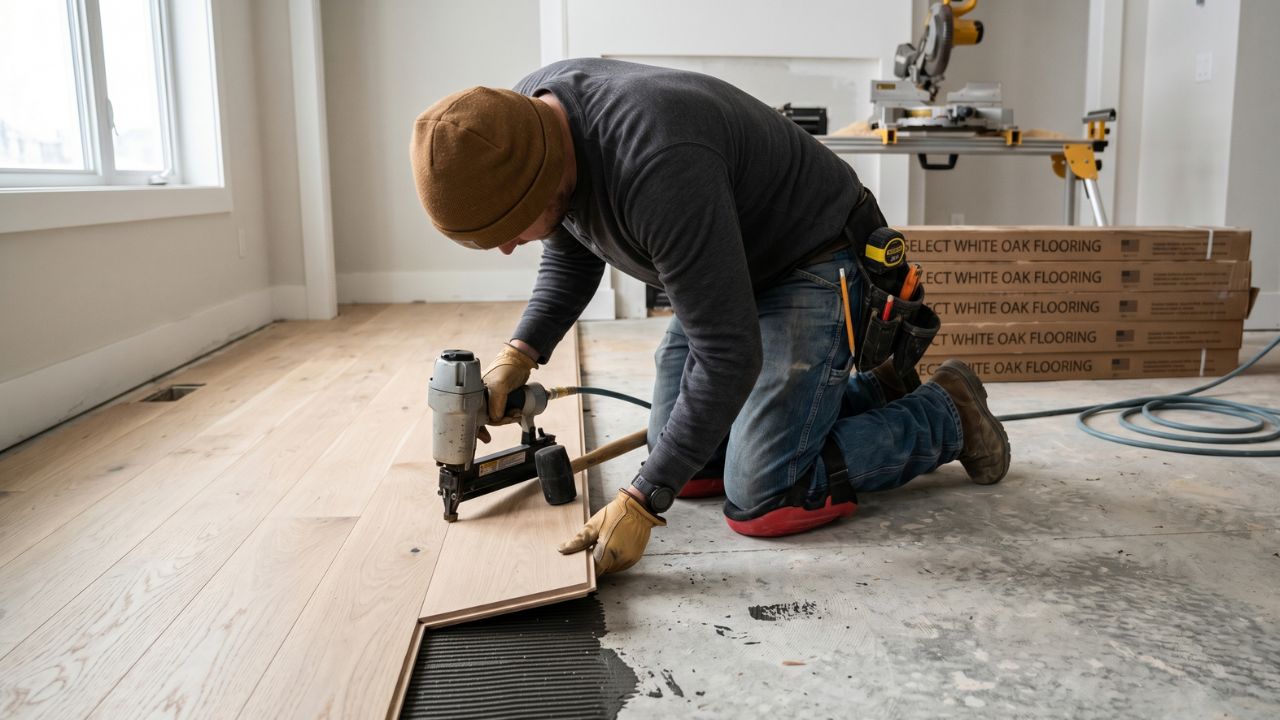
You love the look of hardwood floors. Warm, classic, and timeless. But your home has a concrete subfloor — maybe it's a slab foundation, a basement, or a ground-level addition — and you're not sure if hardwood and concrete can even work together.
Here's the straight answer: yes, you can install hardwood floors on concrete. But it's not as simple as nailing boards down and calling it a day. There are a few important things you need to get right first.
Let's walk through everything.
Why Concrete and Hardwood Are a Tricky Combo
Wood and concrete have a complicated relationship. Here's why:
Wood breathes. It expands and contracts with changes in humidity and temperature. Concrete, on the other hand, just sits there — rigid and cold. When wood is stuck against concrete without the right prep, that movement causes problems. Boards can buckle, cup, warp, or crack over time.
Concrete holds moisture. Even a slab that looks and feels dry can release moisture vapor. That moisture gets absorbed by the wood and causes it to swell, warp, or develop mold underneath.
That's why preparation is everything when installing hardwood over concrete. Skip the prep steps and you'll be pulling up ruined floors in a few years.
Step One Before Anything Else — Test for Moisture
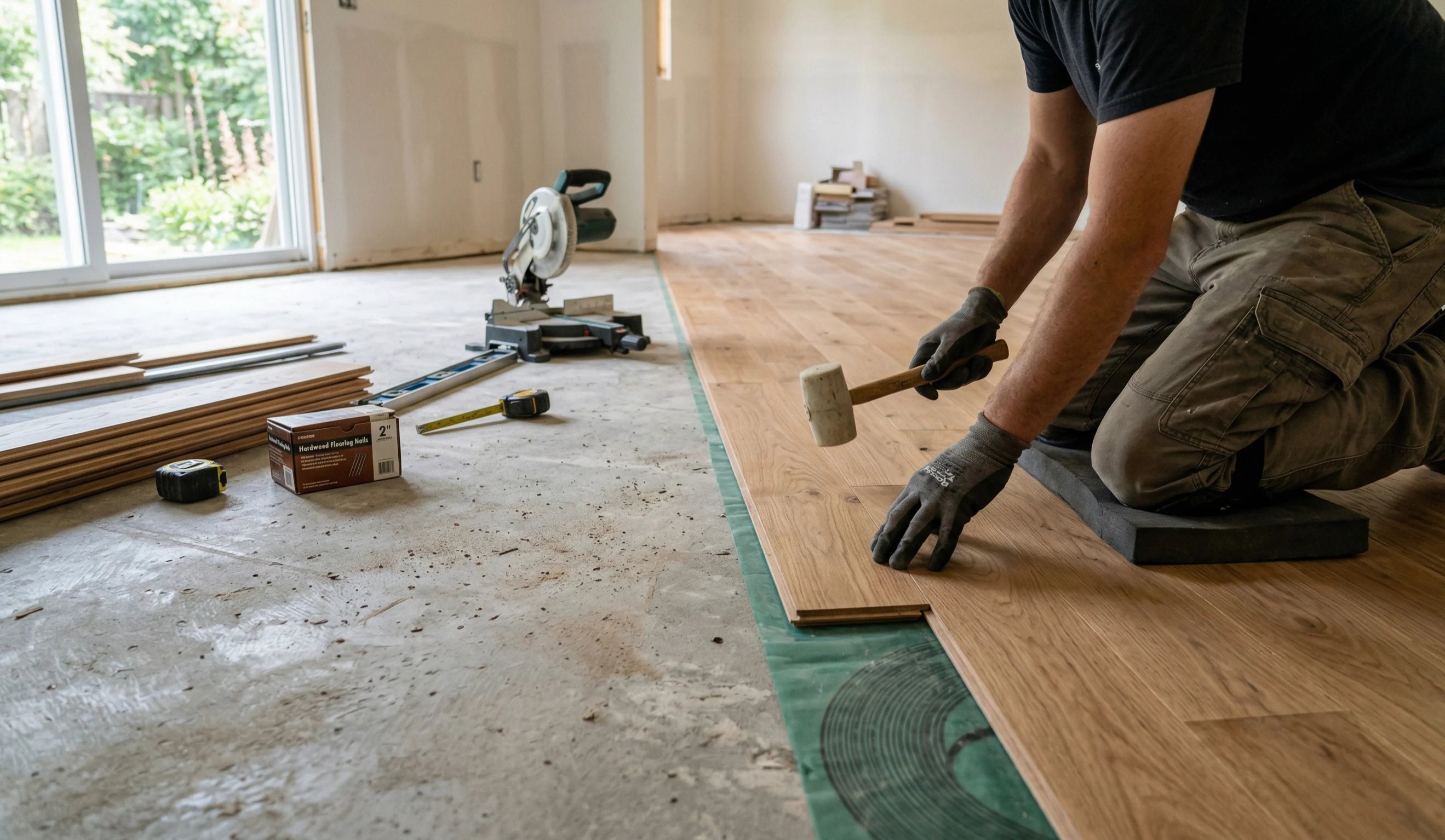
This is the most important thing you can do before buying a single plank of wood.
Concrete slabs release moisture vapor constantly — even ones that seem completely dry. If that moisture gets into your hardwood, you've got a big problem.
Here are two simple ways to test:
Plastic Sheet Test
Tape a 2-foot square piece of plastic sheeting flat against the concrete. Seal all four edges with tape. Leave it for 24 to 48 hours. If you come back and find moisture or condensation under the plastic — the concrete is too wet to install hardwood without proper treatment first.
Calcium Chloride Test
This is a more precise method. You can buy a calcium chloride moisture test kit at most home improvement stores. It gives you a measurable reading of how much moisture vapor the slab is releasing.
The general rule: moisture emission should be 3 lbs or less per 1,000 sq ft per 24 hours before hardwood installation is considered safe.
If moisture levels are too high, you'll need to apply a moisture barrier or vapor retarder before moving forward.
Three Ways to Install Hardwood Over Concrete
Once your moisture situation is under control, there are three main installation methods to choose from.
Method 1: Glue-Down Installation
This is the most common method for installing hardwood directly on concrete. A special flooring adhesive is spread over the concrete slab, and the hardwood planks are pressed down into it one by one.
Best for: Solid hardwood and engineered hardwood on ground-level or above-grade slabs.
Pros:
- Very stable and solid underfoot
- No bounce or flex when walking
- Works well in most rooms
Cons:
- Messy and time-consuming to install
- Hard to remove later if you want to change the floors
- Requires a very flat concrete surface — any dips or bumps show through
Important: You must use the adhesive recommended by your flooring manufacturer. Using the wrong product can void your warranty and cause installation failure.
Method 2: Floating Floor Installation
With this method, the hardwood planks are not attached to the concrete at all. Instead, they lock together and "float" over a thin foam or cork underlayment. The whole floor moves slightly as one unit.
Best for: Engineered hardwood — this method is not recommended for solid hardwood.
Pros:
- Easiest DIY-friendly method
- No adhesive mess
- Can be installed over minor imperfections in the concrete
- Easy to remove and reinstall if needed
Cons:
- Can feel slightly hollow or bouncy underfoot
- Not ideal for high-traffic or heavy furniture areas
- Planks can separate over time if humidity fluctuates a lot
This method is popular for basement installations where gluing down isn't practical.
Method 3: Nail-Down Over a Plywood Subfloor
This is the traditional method — and it works beautifully. You first install a layer of plywood directly onto the concrete using concrete screws or construction adhesive. Then you nail or staple the hardwood planks into the plywood just like you would over a wood subfloor.
Best for: Solid hardwood planks that need something to nail into.
Pros:
- Feels most like a traditional hardwood floor — solid and natural underfoot
- Works with virtually any hardwood species or width
- Plywood layer adds insulation and cushion
Cons:
- Raises the floor height by about 1.5 inches — can cause issues with doors and transitions
- More labor-intensive and expensive
- Requires moisture barrier between concrete and plywood
This is the best method if you want the authentic feel of solid hardwood and you have the ceiling height to accommodate it.
Solid Hardwood vs. Engineered Hardwood — Which Is Better for Concrete?
This comes up a lot and it's worth addressing directly.
Solid Hardwood
Solid hardwood is exactly what it sounds like — a single solid piece of wood from top to bottom. It's beautiful, can be refinished multiple times, and lasts generations.
The downside? It's more sensitive to moisture and humidity changes. For that reason, solid hardwood is not recommended for below-grade installations like basements. On a ground-level slab that passes the moisture test, it can work — but only with the nail-down over plywood method.
Engineered Hardwood
Engineered hardwood has a real wood veneer on top but is built with multiple layers of plywood or HDF underneath. Those layers are cross-stacked, which makes the board much more dimensionally stable — meaning it handles moisture and temperature changes far better than solid wood.
Engineered hardwood is the better choice for concrete in most situations. It can be glued down, floated, or nailed down, and it works in basements and ground-level slabs alike.
It still looks like real wood — because the top layer is real wood. Most people can't tell the difference once it's installed.
Preparing the Concrete Before Installation
No matter which method you choose, the concrete needs to be properly prepped. Here's what that looks like:
Flatten It Out
Hardwood floors need a flat surface. The concrete should be flat within 3/16 of an inch over a 10-foot span. Use a long straightedge or level to check for high spots and low spots.
High spots get ground down with a concrete grinder. Low spots get filled with self-leveling concrete compound. Let it cure fully before moving forward.
Clean It Thoroughly
Sweep, vacuum, and mop the slab. Remove any paint, old adhesive, oil, or debris. A clean surface is critical for good adhesive bond and proper installation.
Let It Acclimate
Once your hardwood is delivered, let it sit in the room where it will be installed for at least 48 to 72 hours — some manufacturers recommend up to a week. This lets the wood adjust to the temperature and humidity of the space before installation begins.
Stack the boxes loosely so air can circulate around them. Don't skip this step — it makes a real difference.
What About Basements?
Basements are the trickiest spot for hardwood floors. They tend to be cooler, more humid, and more prone to moisture issues than above-grade spaces.
Solid hardwood in a basement is generally a bad idea. The moisture risk is just too high.
Engineered hardwood with a proper moisture barrier and floating or glue-down installation is the way to go in a basement. Many engineered hardwood products are specifically designed and warranted for below-grade use — look for that when shopping.
If your basement has any history of flooding or serious moisture problems, consider luxury vinyl plank instead. It's 100% waterproof and looks remarkably similar to hardwood.
How Much Does It Cost?
Here's a rough breakdown of what to expect:
| Item | Estimated Cost |
|---|---|
| Engineered hardwood (materials) | $3 – $10 per sq ft |
| Solid hardwood (materials) | $5 – $15 per sq ft |
| Moisture barrier / underlayment | $0.25 – $1 per sq ft |
| Professional installation | $3 – $8 per sq ft |
| Self-leveling compound (if needed) | $1 – $3 per sq ft |
For a 300 sq ft room, you're looking at roughly $2,000 to $5,500 installed, depending on the wood species and your location.
Common Mistakes to Avoid
Skipping the moisture test. This is the number one mistake. Always test before you install — no exceptions.
Not acclimating the wood. Rushing this step leads to warping and gapping after installation.
Using the wrong adhesive. Always use the product recommended by your flooring manufacturer. The wrong adhesive can cause the planks to release from the floor.
Ignoring a high spot or dip. Even a small bump in the concrete can cause planks to crack or joints to separate over time. Take the time to flatten the slab properly.
Installing solid hardwood in a basement. Just don't do it. Use engineered hardwood instead.
Bottom Line
Yes, you can absolutely install hardwood floors on concrete — and when done right, it looks incredible and lasts for decades. The key is controlling moisture, choosing the right type of hardwood, and using the right installation method for your situation.
Take your time with the prep work. Test for moisture. Let the wood acclimate. And if you're not confident doing it yourself, hire a flooring professional — this is one of those projects where getting it right the first time saves you a lot of money and headache down the road.
Your dream hardwood floors are absolutely possible — even on a concrete slab.