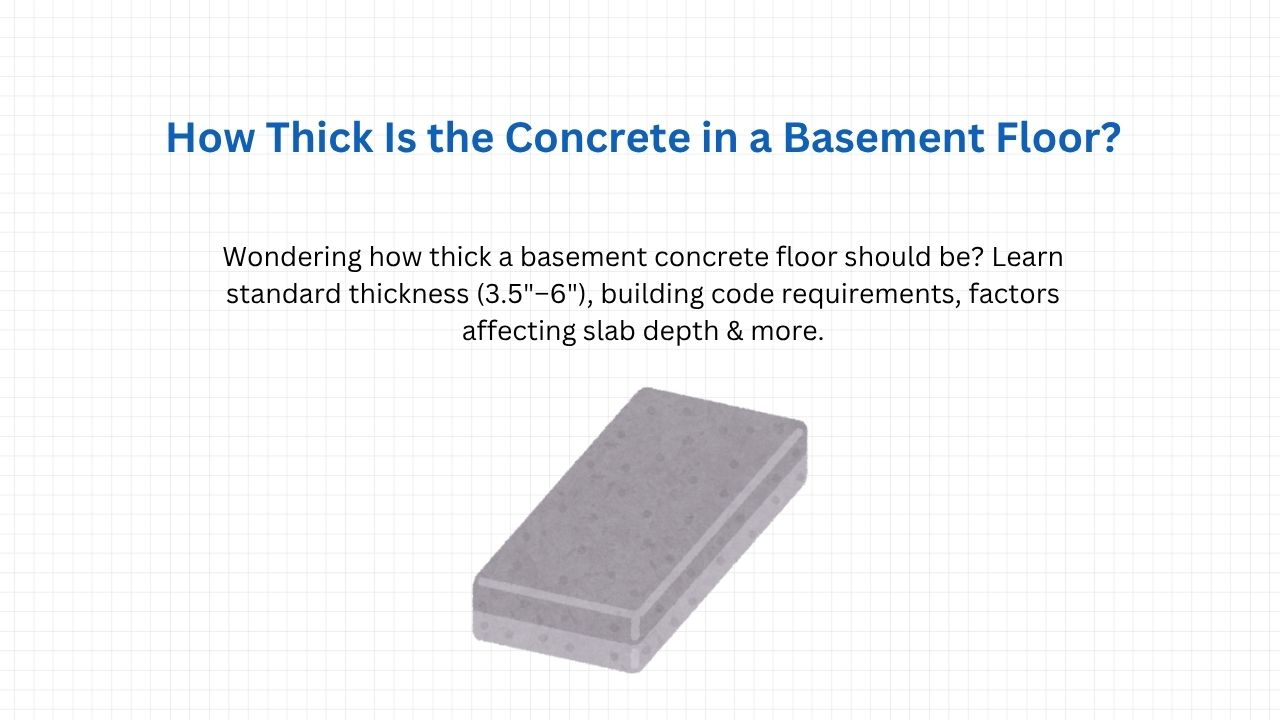
If you're planning a basement renovation, finishing your basement, or simply curious about the structure beneath your feet, one of the most common questions is — how thick is a basement floor concrete slab?
The answer isn't a single fixed number. It depends on the type of structure, load requirements, soil conditions, and local building codes. In this guide, we'll cover everything you need to know about basement floor thickness — from standard measurements to factors that influence it.
What Is the Standard Thickness of a Basement Concrete Floor?
Generally speaking, most residential basement concrete floors are poured to a thickness of around 4 inches. This is a pretty standard benchmark as it provides sufficient strength to support typical household loads, including furniture, appliances, and the weight of the structure above. It also offers a good balance between material cost and structural integrity.
As per standard engineering references, home basement floors typically require a minimum of 4 inches (0.1 m) of concrete thickness.
If your basement has any load-bearing walls, columns, or a chimney, these areas should have footings already in place before the floor is poured. If not, those areas should be thickened as per local code and a mat of rebar added for extra strength.
Thickness by Use — What Type of Basement Are You Building?
Not every basement is the same. Here's a breakdown based on use:
Standard Residential Basement (Utility/Storage)
A standard poured concrete slab for a non-finished basement used mainly as a utility or foundation slab is typically 3.5 to 4 inches (90–100 mm).
Finished Living Space Basement
A finished or garage-adjacent basement slab is commonly 4 to 6 inches (100–150 mm) when more durability is desired or for light floor loads.
Basement with Radiant Heating or Heavy Loads
Where embedded hydronic tubing, thicker reinforcement, or higher load capacity is required, the thickness ranges from 5 to 8 inches (125–200 mm).
What Does the Building Code Say?
The International Residential Code (IRC) specifies a minimum basement slab thickness of 3.5 inches. This requirement coincides with the minimum concrete strength requirement of 2,500 psi.
As per ACI 117 Standard for Tolerances, the average of four core thickness samples should not vary by more than 3/8 inch from the specified minimum thickness.
Note: Always check your local building code — requirements may vary by region, especially in areas with frost lines, expansive soils, or seismic activity.
What Goes Beneath the Concrete Slab?
The concrete slab is just one layer of the basement floor system. A properly built basement floor typically includes:
4 to 6 inches of compacted granular fill (crushed stone or gravel) under the slab for drainage and uniform support. Brick & Bolt On top of that, a 6-mil plastic vapor/moisture barrier is laid to prevent dampness from rising into the slab. In colder climates, 1–2 inches of polystyrene insulation foam is added before the concrete pour. The concrete slab is then poured on top, often with wire mesh or rebar reinforcement embedded within it.
So the total depth from concrete surface to dirt can be 6 to 8 inches or more, even if the slab itself is only 4 inches thick.
Factors That Affect Basement Floor Thickness
Several key factors influence how thick your basement floor should be:
1. Soil Conditions Weak, expansive, or poorly compacted soil requires a thicker slab to prevent cracking and settlement. In areas with expansive clay soils, a 6-inch slab is often recommended.
2. Load Requirements A basement used as a gym, workshop, or storage for heavy equipment needs a thicker slab than one used only as a laundry room.
3. Reinforcement Used Many basement floors, even those that are 4 inches thick, have reinforcement like wire mesh or rebar embedded within the concrete. This reinforcement helps hold the concrete together if hairline cracks form, preventing them from widening and compromising the slab's integrity.
4. Local Climate & Frost Depth In regions with deep frost lines, thicker slabs and proper sub-base preparation are essential to prevent heaving and cracking during freeze-thaw cycles.
5. Concrete Mix Strength For interior basement floors, a 3,000 psi concrete mix is commonly recommended by experienced contractors.
Quick Reference Table
| Basement Type | Recommended Thickness | Reinforcement |
|---|---|---|
| Utility / Storage | 3.5 – 4 inches | Wire mesh |
| Finished Living Space | 4 – 5 inches | Rebar or mesh |
| Heavy Load / Workshop | 5 – 6 inches | Rebar |
| Radiant Heating | 5 – 8 inches | Rebar |
| Expansive Clay Soils | 6 inches minimum | Rebar |
How to Check the Thickness of Your Existing Basement Floor
If you're unsure how thick your current basement slab is, here's a simple DIY method: drill a small hole through the slab with a masonry bit, then bend the end of a wire or paper clip into a hook, insert it through the hole, feel for the bottom of the slab, mark the wire at the top surface, and measure the distance. This tells you your exact slab thickness without any expensive coring.
Signs Your Basement Floor Is Too Thin
Watch out for these warning signs that your slab may be undersized:
- Visible cracks that widen over time
- Uneven or sunken floor areas
- Moisture seeping through the floor surface
- Hollow sound when walking across the floor
If you notice any of these, consult a structural engineer before proceeding with any renovation work.
Final Thoughts
While 4 inches is the most common answer for a residential basement concrete floor, it's a guideline, not an absolute rule. The actual thickness is a thoughtful engineering decision, designed to keep your home standing strong and stable for years to come.
When in doubt, always consult a licensed structural engineer — especially if you're planning to add heavy loads, install radiant heating, or renovate an older home where the original slab thickness is unknown.