When it comes to reinforced concrete construction, not all rebar is created equal. Choosing the right type of reinforcing bar directly impacts the strength, durability, and lifespan of your structure. Whether you're building a home, a bridge, or a coastal facility, understanding the different types of rebar available — and when to use each — is essential knowledge for every engineer and contractor.
In this guide, we'll break down the most common types of rebar used in construction today, their properties, and their ideal applications.
1. Mild Steel (Plain) Bars — The Old Standard
Mild steel bars are the oldest form of reinforcement, featuring a smooth and plain surface. The diameter of mild steel bars varies from 6 mm to 50 mm. These bars cannot develop a good bond with concrete, hence hooks are essentially required at the ends.
Mild steel bars are used in small projects where the budget is low. With the introduction of deformed and twisted bars, the use of mild steel bars in construction is rapidly decreasing.
Grade as per IS Code: Fe-250 Best for: Minor repair works, small residential projects
2. HYSD Bars — High Yield Strength Deformed Bars
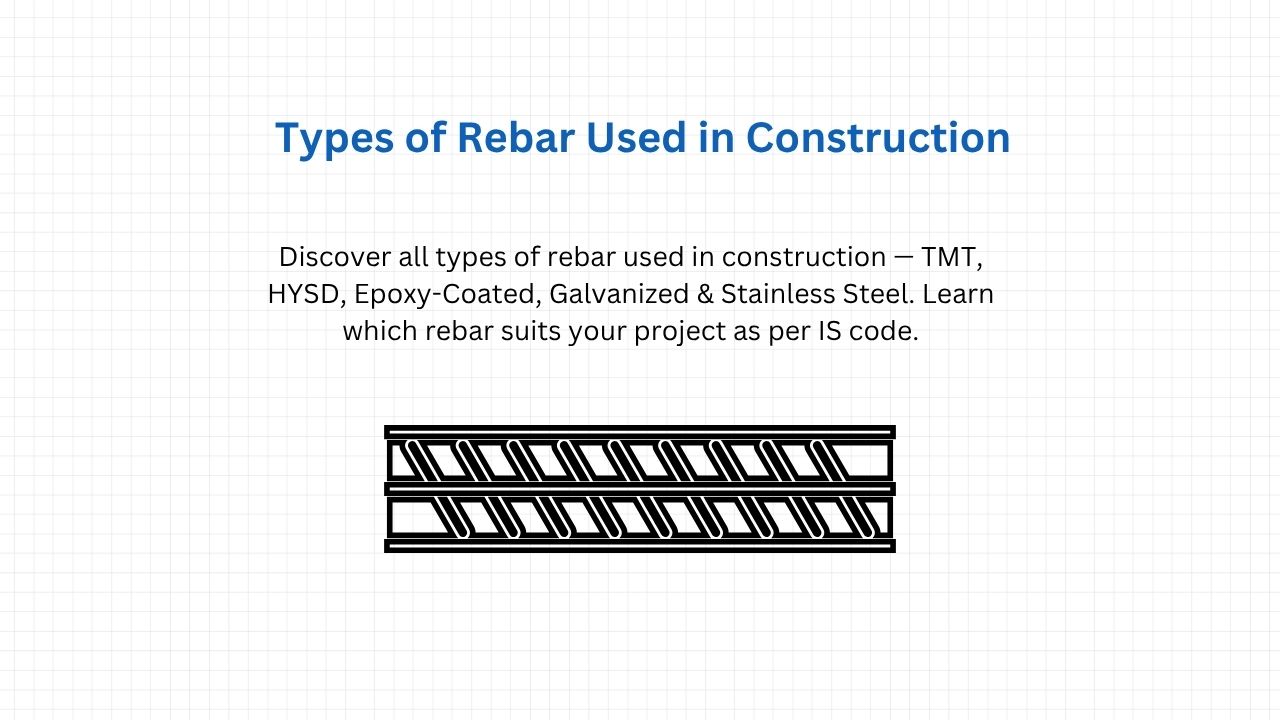
HYSD (High Yield Strength Deformed) bars were a major upgrade over plain mild steel bars. HYSD bars are distinguished by a ribbed rough surface on the bar. This is done in order to increase the bar bonding between reinforcement and concrete and to maintain friction between them.
HYSD bars have enhanced strength and ductility compared to mild steel bars, making them suitable for heavy-duty construction such as high-rise buildings, bridges and industrial structures.
HYSD bars are further divided into two categories — Cold Twisted Deformed (CTD) bars and TMT bars (covered below). Most modern construction incorporates TMT bars, which perform better and are manufactured with more advanced processes than HYSD.
Best for: Structural beams, columns, heavy-duty RCC work
3. TMT Bars — The Gold Standard in Modern Construction
TMT (Thermo-Mechanically Treated) bars are currently the most widely used rebar type in India and across the world. TMT or thermo mechanical treatment is an advanced process in which red hot rebars are quenched through a series of water jets making a hardened outer layer surface surrounding a softer core.
This unique manufacturing process gives TMT bars several advantages:
- High tensile strength with excellent ductility
- Earthquake resistance due to the soft core that absorbs seismic energy
- Fire resistance — TMT bars can withstand high temperatures up to 600 degrees Celsius, providing added safety in case of fire.
- Easy weldability — Due to their low carbon content, TMT bars can be easily welded without losing strength, making construction easier and more efficient.
Grades available: TMT bars come in different grades, such as Fe 415, Fe 500, Fe 550, and Fe 600. The higher the grade, the stronger the bar.
Best for: Residential buildings, commercial structures, bridges, dams, high-rise buildings
Pro Tip: For most construction in India, Fe 500 or Fe 500D grade TMT bars are recommended. The "D" suffix indicates higher ductility — ideal for earthquake-prone zones.
4. Epoxy-Coated Rebar — Built for Harsh Environments
The purpose of epoxy-coated rebar is to serve as a protective system against moisture and chlorides that could erode the surface of the reinforcing bar. To create epoxy-coated rebar, hot steel is sprayed with epoxy powder using an electrostatic sprayer set to a specific temperature.
This type of rebar is ideal for structures that are exposed to saltwater or where there is an increased risk of corrosion. The epoxy coating increases the corrosion resistance from 70 to 1,700 times that of black bar.
However, there is one important drawback — the external coating can be prone to damage during transport or rough handling. If the coating is compromised, it reduces the overall effectiveness.
Best for: Coastal structures, marine construction, bridges, ports, parking garages, areas with high humidity
5. Galvanized Rebar — Zinc-Coated Protection
When a rebar is coated with zinc it is then known as galvanised rebar. Featuring excellent corrosion resistance, they perform better than epoxy-coated rebars.
The zinc layer acts as a sacrificial coating — it corrodes first before the steel underneath is affected, giving the bar a significantly longer service life in moist or chemically aggressive environments.
Best for: Bridges, infrastructure in humid climates, underground structures
6. Stainless Steel Rebar — Premium and Long-Lasting
Stainless steel rebar is one of the best types of rebar used where high corrosion resistance is desirable or where repair is difficult and expensive. However, these rebars are at least 8 times more costly than epoxy-coated rebars.
Stainless steel rebars have a long lifespan, are highly corrosion resistant, and less maintenance is required compared to other kinds of steel.
Best for: Marine structures, chemical plants, high-value infrastructure where long-term durability justifies the initial cost
Quick Comparison Table
| Type | Strength | Corrosion Resistance | Cost | Best Use |
|---|---|---|---|---|
| Mild Steel | Low | Low | Low | Small projects |
| HYSD | High | Moderate | Moderate | Heavy structures |
| TMT | Very High | Good | Moderate | All general construction |
| Epoxy-Coated | High | Very High | High | Coastal/marine |
| Galvanized | High | Excellent | High | Bridges, humid zones |
| Stainless Steel | High | Highest | Very High | Specialty projects |
Which Rebar Should You Choose?
For most residential and commercial construction in India, TMT bars (Fe 500/Fe 500D) are the best all-round choice — strong, ductile, weldable, and cost-effective.
For coastal or marine projects in cities like Mumbai, Chennai, or Kochi, opt for epoxy-coated or galvanized rebar to fight chloride attack.
For critical infrastructure where long-term durability is non-negotiable and maintenance is difficult, stainless steel rebar is worth the premium investment.
Always consult a structural engineer and ensure your chosen rebar complies with IS 1786:2008 standards before procurement.
Final Thoughts
Rebar selection isn't just a material decision — it's a structural and financial one. The wrong choice can lead to premature corrosion, costly repairs, or even structural failure down the line. Understanding the properties of each type helps you make smarter decisions for every project, big or small.
Have questions about rebar selection for your specific project? Drop them in the comments below!