If you are planning a new home build, a major addition, or even a detached garage, you will eventually hit a critical question from your builder or architect: "Do you want 2x4 or 2x6 exterior walls?"
For decades, the 2x4 was the undisputed king of construction. It was cheap, strong enough, and easily available. But as energy prices rise and building codes demand better efficiency, the thicker 2x6 wall is fast becoming the new standard in many regions.
Is the upgrade worth the extra cost? This guide breaks down the real differences so you can decide where to spend your budget.
First: The "Lumber Lie" (Nominal vs. Actual)
Before comparing them, we need to clear up a common confusion in construction. Lumber is rarely the size its name suggests.
When a board is rough-cut from a log, it is nominally 2 inches by 4 inches. But after it is dried and smoothed down (planed) at the mill, it shrinks.
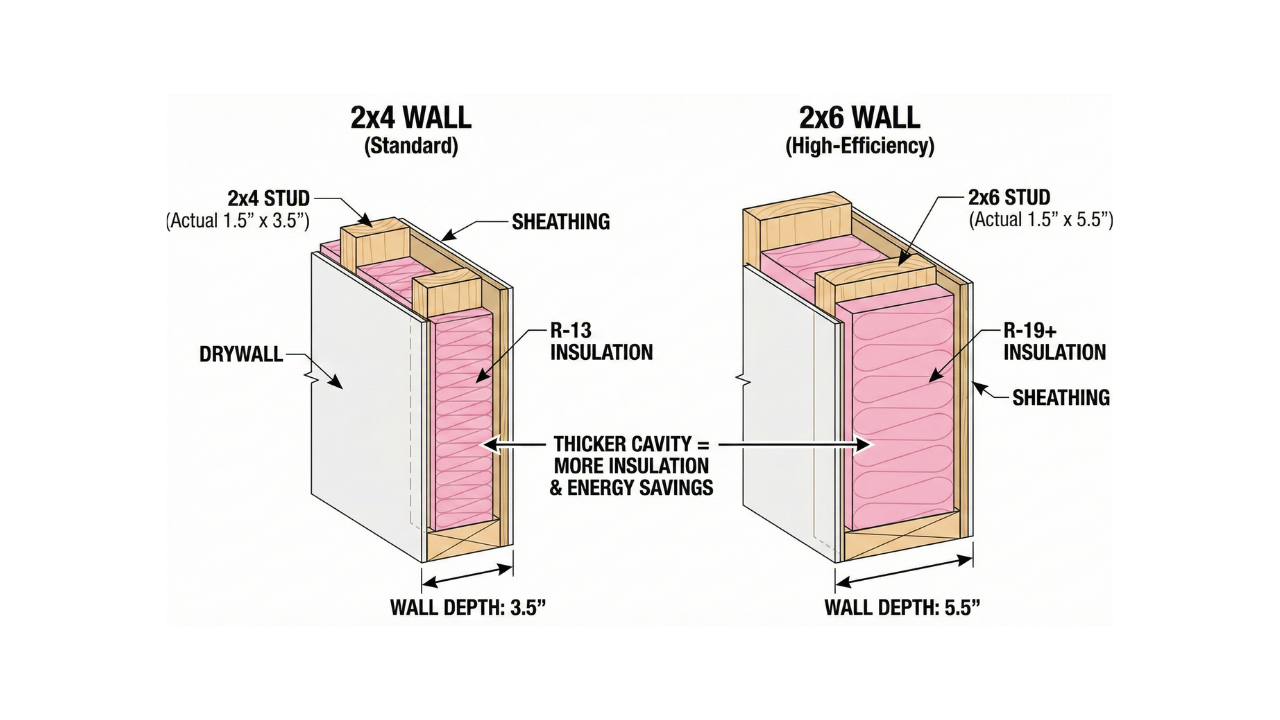
- A "2x4" is actually: 1.5 inches thick by 3.5 inches deep.
- A "2x6" is actually: 1.5 inches thick by 5.5 inches deep.
The Key Takeaway: The thickness where you nail on drywall (the "2") is exactly the same on both. The difference is entirely in the depth of the wall cavity. A 2x6 wall is exactly 2 inches deeper than a 2x4 wall.
The Main Event: Insulation and Energy Efficiency (R-Value)
This is the #1 reason anyone chooses 2x6 walls. That extra two inches of depth isn't for strength; it's space for insulation.
In the world of insulation, "R-Value" measures resistance to heat flow. The higher the R-value, the better your wall keeps heat in during winter and heat out during summer.
The 2x4 Wall Limit
Because the cavity is only 3.5 inches deep, you are limited in how much insulation you can stuff in there without compressing it (which ruins its effectiveness).
- Standard Fiberglass Batt: Typically maxes out around R-13 to R-15.
- Verdict: Adequate for mild climates, but often fails to meet modern energy codes in colder regions without adding expensive rigid foam to the outside of the house.
The 2x6 Wall Advantage
That extra depth allows for thicker, denser insulation batts.
- Standard Fiberglass Batt: Can easily accommodate R-19, R-21, or even R-23 high-density batts.
- Verdict: A massive improvement in energy efficiency. Over the 30-year life of a mortgage, the energy bill savings from R-21 walls vs. R-13 walls can be substantial.
Structural Strength and "Advanced Framing"
Are 2x6 walls stronger? Yes, significantly. A 2x6 stud has more wood fiber and can handle much heavier vertical loads (like a heavy snowy roof or a second story).
Because they are stronger, builders can use a technique called "Advanced Framing" (or 24" OC Framing):
- Standard 2x4 Wall: Studs must usually be placed every 16 inches on center.
- Stronger 2x6 Wall: Studs can often be spaced out every 24 inches on center.
Why does this matter?
Wood is a terrible insulator. Heat travels right through a wooden stud faster than it travels through insulation (this is called "thermal bridging"). By using 2x6s spaced at 24 inches, you use fewer studs in the wall. Fewer studs mean more room for insulation and less wood touching the outside air. It's a win-win for efficiency.
The Reality Check: Cost and Lost Space
If 2x6 is so much better, why doesn't everyone use it? There are two major downsides: upfront cost and interior space.
1. The Cost Premium
It is not just the cost of the wood board itself.
- Lumber: 2x6 studs cost roughly 30% to 40% more than 2x4s.
- Insulation: Thicker insulation costs more.
- Window and Door Jambs: This is a hidden cost. Standard windows are designed for 2x4 walls. If you use 2x6 walls, you need "extension jambs" to make the window frame reach the interior drywall. This adds labor and material cost to every single window and door.
2. The Lost Floor Space
Those extra two inches have to come from somewhere.
If you build a house with a 1,000 sq ft footprint using 2x6 exterior walls instead of 2x4, those thicker walls will "eat" into your interior living space. You might lose roughly 20-30 square feet of usable interior floor area compared to the same house built with 2x4s. It doesn't sound like much, but in tight areas like hallways or small bathrooms, those two inches matter.
Summary Comparison Table
| Feature | 2x4 Wall | 2x6 Wall | Winner |
| Actual Depth | 3.5 inches | 5.5 inches | N/A |
| Max Insulation (Batt) | ~R-15 | ~R-21+ | 2x6 (By far) |
| Typical Spacing | 16" on center | 24" on center | 2x6 (More efficient) |
| Material Cost | Lower | 30-50% Higher | 2x4 |
| Interior Space | Maximizes floor space | Loses ~2" around perimeter | 2x4 |
| Sound Dampening | Good | Better (Thicker wall) | 2x6 |
Final Verdict: Which Should You Choose?
The decision almost always comes down to your climate zone and your budget timeline.
Stick with 2x4 Walls If:
- You live in a mild climate (like Southern California or Florida) where intense cold is rare.
- Your upfront budget is extremely tight, and you cannot afford the premium materials.
- You are building a small ADU or shed where every inch of interior floor space is critical.
Upgrade to 2x6 Walls If:
- You live in a region with real winters (the Midwest, Northeast, Canada, etc.). The energy savings will pay for the upgrade in just a few years.
- You are building your "forever home" and want maximum comfort and lower long-term utility bills.
- You want a quieter house; thicker walls block outside traffic noise better.
The Bottom Line: A 2x4 wall is a budget choice focused on today's costs. A 2x6 wall is an investment choice focused on tomorrow's savings.