If your home has brick on the outside, there's a very good chance it's not solid brick at all — it's brick veneer. The same goes for that exposed brick accent wall in your living room or the brick facade on your local coffee shop. Brick veneer is everywhere in the US, and most people can't tell the difference between it and the real thing. That's entirely the point.
Here's everything you need to know about what brick veneer is, how it works, and whether it's the right choice for your home.
What Is Brick Veneer?
Brick veneer is a non-structural layer of brick applied to the outside (or inside) of a building purely for appearance. Unlike solid brick walls, which carry the structural weight of the building, brick veneer is just a decorative facade — if you removed it, the building would stay standing because the actual structure is made of wood or steel framing behind it.
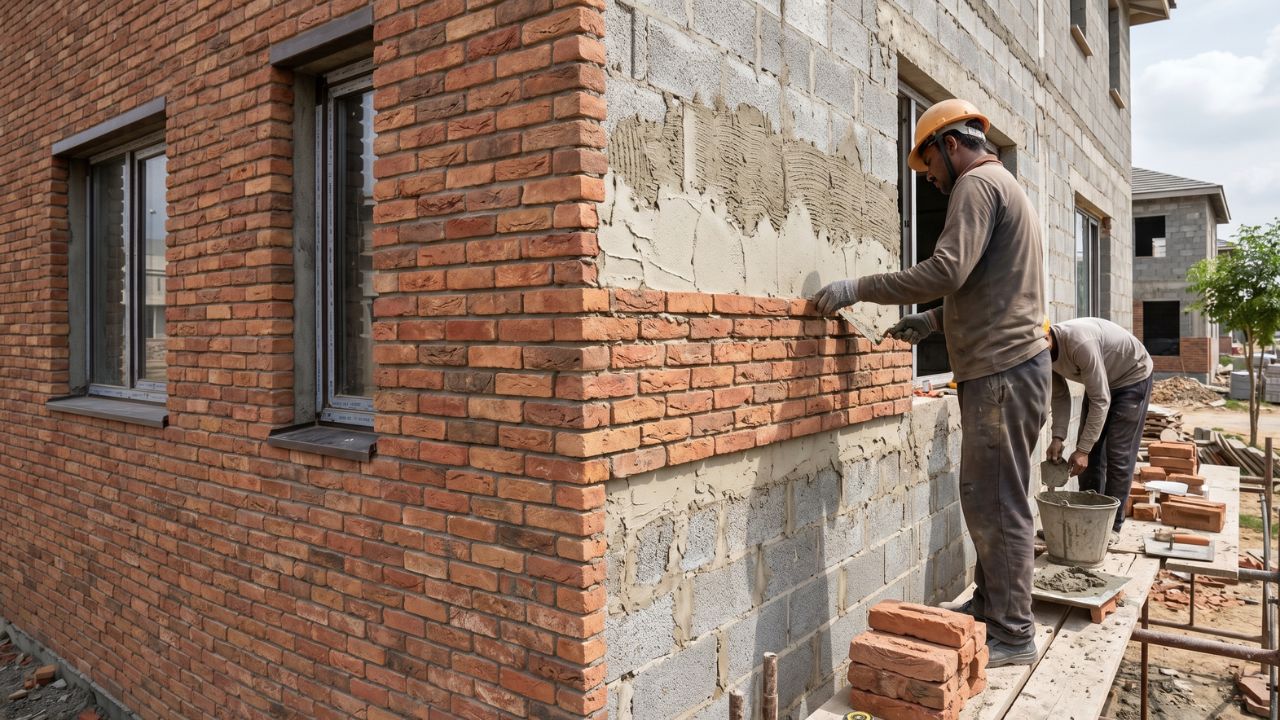
The bricks themselves are exactly the same material as traditional bricks — typically fired clay or concrete. What differs is how they're used. In brick veneer construction, a single layer (called one wythe) of full or thin bricks is attached to the wall framing with metal ties and mortar. A small air gap is left between the brick and the framing to allow ventilation and drainage, keeping moisture out of the wall cavity.
Most US homes built in the last 30 years that appear to be brick are actually brick veneer. It's the dominant brick building method in modern American residential construction.
Brick Veneer vs. Solid Brick: What's the Difference?
The easiest way to tell the difference between a solid brick wall and a brick veneer wall is to look for header bricks — bricks laid sideways with only the short end showing, typically appearing every 6th row. Header bricks tie the inner and outer layers of a solid brick wall together. Brick veneer has no header bricks; all the bricks run horizontally, because there's only one layer.
| Brick Veneer | Solid Brick | |
|---|---|---|
| Structural role | Decorative only | Load-bearing |
| Thickness | One wythe (single layer) | Two or more wythes |
| Insulation | Good — air gap adds insulation | Poor — dense mass, low R-value |
| Cost | $14–$28/sq ft installed | $30–$45+/sq ft installed |
| Installation timing | Can be added any time | Must be built during original construction |
| Weight | Lighter | Much heavier |
Solid brick construction is extremely durable and was the standard in American homes before the mid-20th century. But it costs roughly three times as much as brick veneer, requires a professional mason from day one, and is a poor insulator without additional treatment. Brick veneer gives you the same look at a fraction of the cost and with the flexibility to be installed on any existing structure.
The 3 Types of Brick Veneer
1. Traditional (Full-Thickness) Veneer
This uses standard full-sized bricks installed one wythe thick, anchored to the framing with metal wall ties. It most closely replicates the appearance of solid brick and is the most common choice for new residential construction. It requires a foundation ledge to support the weight of the brick.
2. Thin Brick Veneer
Thin brick veneer is made from real clay bricks that have been sliced into thinner pieces — typically 3/8 to 1 inch thick. It weighs only 4 to 7 pounds per square foot, making it light enough to be applied directly to drywall, cement board, or existing walls using mortar adhesive. It's the go-to choice for interior accent walls, fireplace surrounds, kitchen backsplashes, and renovation projects where adding full-thickness brick isn't practical.
3. Panelized Brick Veneer
Pre-mounted thin bricks bonded to a rigid backing panel (often foam insulation or fiberglass mesh). Panels are large, consistent, and fast to install — making them popular for commercial projects, large facades, and situations where speed and uniformity matter. They're also excellent for DIY-friendly interior applications.
Pros and Cons of Brick Veneer
Pros:
- Delivers the classic look of brick at a significantly lower cost
- Better insulator than solid brick — the air cavity improves thermal performance
- Can be installed on any existing structure, at any stage of construction
- Low maintenance — no painting, staining, or frequent upkeep required
- With proper installation, can last 50+ years
- Available indoors and outdoors in a wide range of colors and textures
Cons:
- Non-structural — provides no added strength to the building
- Weep holes (drainage gaps at the bottom of the veneer) can clog with mortar during installation, trapping moisture behind the brick
- Less resilient than solid brick in severe earthquakes or very high winds
- Requires professional installation for exterior applications to ensure proper waterproofing
- Individual bricks can loosen over time if ties or mortar fail
How Much Does Brick Veneer Cost?
For US homeowners in 2025–2026, expect to pay:
- Materials only: $6–$15 per square foot
- Installed (materials + labor): $14–$28 per square foot
- Full kitchen remodel accent wall or fireplace: $1,500–$5,000 depending on size
- Full home exterior re-cladding: $15,000–$40,000+ depending on square footage and region
Thin brick veneer panels for interior DIY use are the most affordable entry point, starting around $6–$10 per square foot for materials.
Is Brick Veneer Right for Your Home?
For most US homeowners, brick veneer is the smarter choice. It gives you the curb appeal, durability, and low-maintenance benefits of brick without the structural complexity or cost of solid masonry. It can be added to an existing home at any time — during a renovation, a full exterior refresh, or even just to add a single interior feature wall.
The key to making it last is proper installation: a quality moisture barrier, correctly installed weep holes, good mortar work, and metal ties secured to code. Hire an experienced masonry contractor for any exterior work, and inspect the mortar joints every few years to catch any repointing needs early.
Brick veneer won't fool a trained eye up close. But from the street, in photos, and in daily life? It's brick — and it looks great.