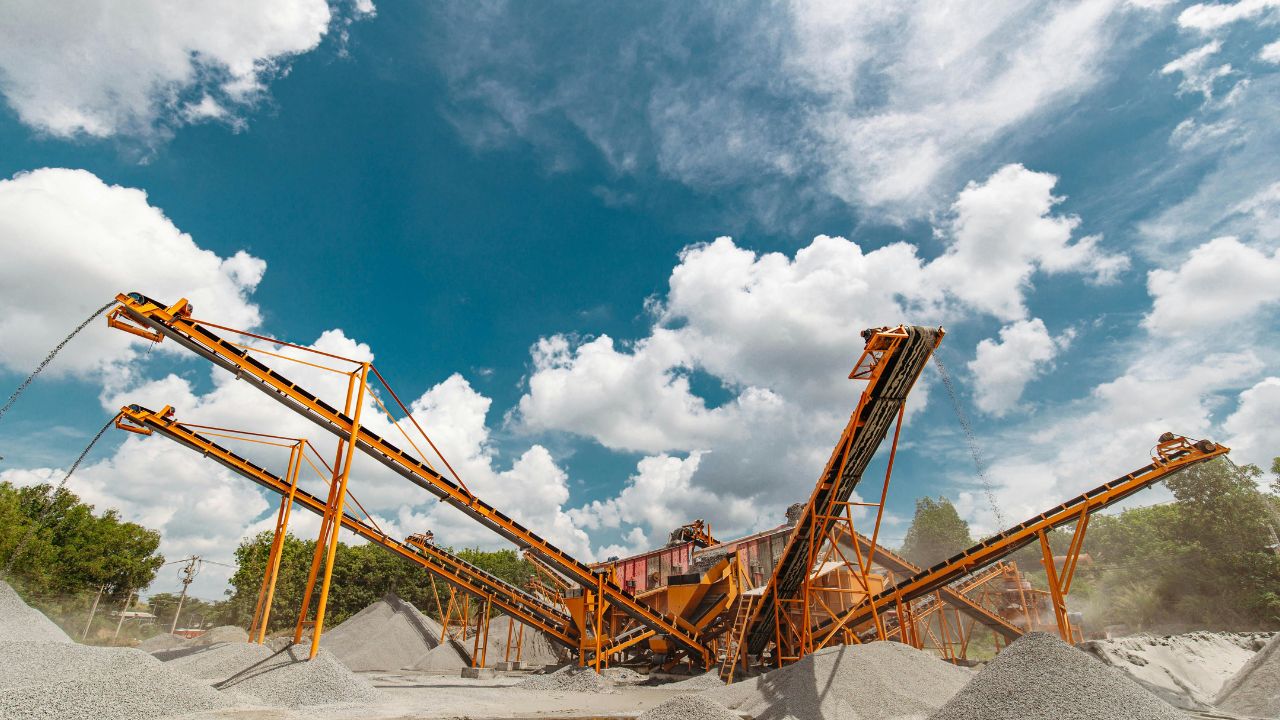
Bulk density tells you how much aggregate mass occupies a given volume, including the air spaces between particles. It is useful for estimating material quantities, comparing aggregate samples, and planning storage or transport. The result depends on the aggregate’s grading, moisture, and how tightly it is packed.
Bulk Density Formula
Calculate bulk density by dividing the aggregate’s mass by the total volume it occupies:
For a result in kilograms per cubic meter, use mass in kilograms and volume in cubic meters:
The volume is the space occupied by the aggregate in the container—not just the combined solid volume of individual particles. This is what makes the result a bulk density measurement.
What You’ll Need
- A container with a known volume
- A scale suitable for weighing the aggregate
- A sample of aggregate
- The container’s empty, or tare, mass
For a practical estimate, use a representative sample and keep the measurement method consistent. Loose-filled aggregate and compacted aggregate can produce different results.
Step-by-Step Calculation
- Measure the container’s volume. Use a container with a known volume, such as 0.01 m³.
- Weigh the empty container. Record its tare mass.
- Fill the container consistently. Avoid changing the filling or compaction method between samples.
- Weigh the filled container.
- Find the aggregate’s net mass. Subtract the empty-container mass from the filled-container mass.
- Divide net mass by container volume. Use compatible units to calculate bulk density.
Example Calculation
Suppose a container has a volume of 0.01 m³. The empty container weighs 2 kg, and the filled container weighs 18 kg.
First, calculate the aggregate’s net mass:
Then calculate its bulk density:
The sample’s estimated bulk density is 1,600 kg/m³.
You can also use the Aggregate Density Calculator to calculate density from mass and volume.
Loose and Compacted Bulk Density
Bulk density can differ depending on how the aggregate is placed in the container:
-
Loose bulk density measures aggregate poured into a container without deliberate compaction.
-
Compacted bulk density measures aggregate after a defined compaction procedure.
Always note which condition your result represents. For formal testing, follow the applicable test method, such as ASTM C29/C29M, which covers bulk density in loose or compacted conditions and void calculations for aggregate. ASTM C29/C29M
Common Unit Conversions
If your measurements use different units, convert them before dividing. For example:
For density in kg/m³, convert the mass to kilograms and volume to cubic meters first.
What Can Affect the Result?
Aggregate bulk density may change with:
- Particle size distribution and shape
- Moisture content
- How the sample is placed or compacted
- Container shape and filling consistency
Because of these factors, a calculator result is an estimate based on the mass and volume entered. For quality control, specifications, or engineering work, use the required laboratory test procedure and project standards.
Conclusion
To calculate aggregate bulk density, measure the net mass of a sample, determine the volume it occupies—including the spaces between particles—and divide mass by volume. Keeping the units and filling method consistent makes results easier to compare and more useful for material planning.