What is Room Volume Calculator?
Use this Room Volume Calculator to find the total three-dimensional space inside a room. Enter the room length, width, and height to calculate its volume in cubic feet, cubic meters, or another cubic unit.
Room volume is useful for HVAC planning, ventilation estimates, construction, storage planning, room design, and general space calculations.
How to Use the Room Volume Calculator
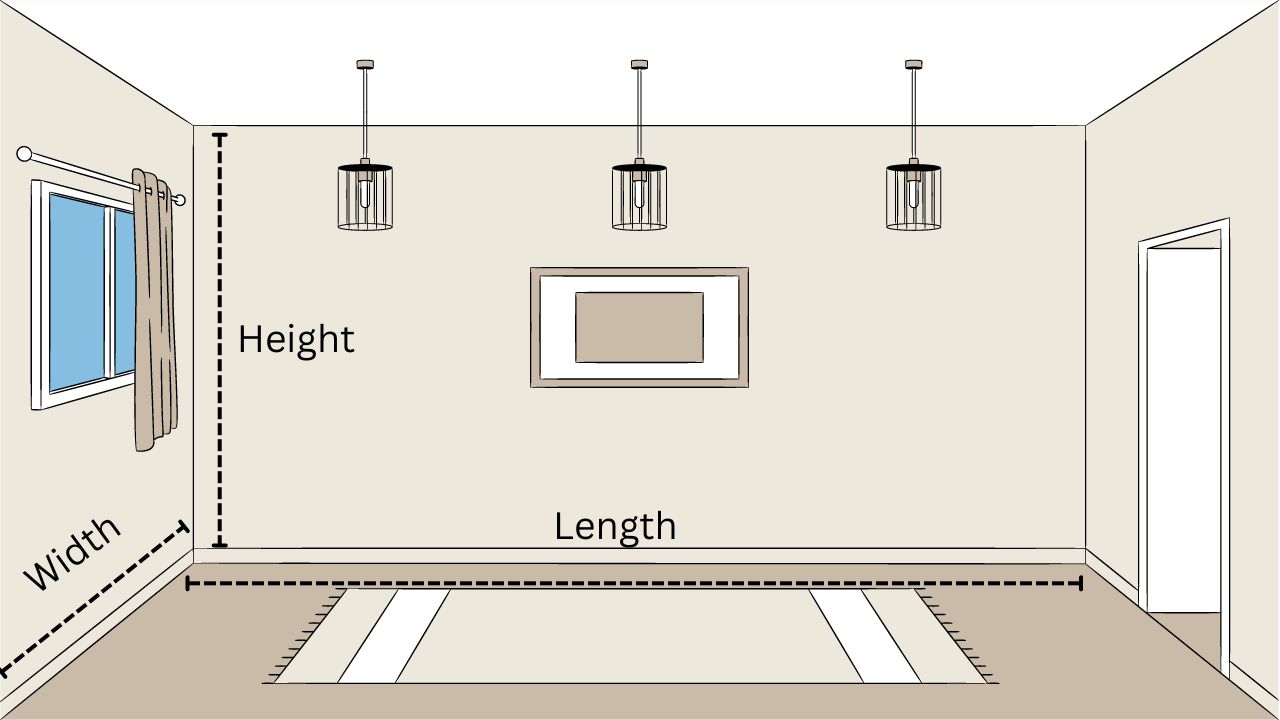
Enter the following room dimensions:
- Length: The longest horizontal measurement of the room.
- Width: The shorter horizontal measurement of the room.
- Height: The vertical distance from the finished floor to the ceiling.
Use the same unit for all three measurements. For example, enter all values in feet or all values in meters.
The calculator returns the total volume of the room in cubic units.
Room Volume Formula
For a rectangular or square room, use this formula:
Room volume=Length×Width×Height
The answer is shown in cubic units:
- Feet × feet × feet = cubic feet
- Meters × meters × meters = cubic meters
Room Volume Example
Suppose a room has these dimensions:
- Length: 5 m
- Width: 4 m
- Height: 3 m
Room volume=5m×4m×3m
Room volume=60m3
The room volume is 60 cubic meters.
How to Calculate Volume for an Irregular Room
The standard room volume formula works best for rectangular rooms with a flat ceiling. For an L-shaped room, a room with alcoves, or a space with different ceiling heights, divide the room into smaller simple sections.
Calculate the volume of each section separately, then add the results.
Total room volume=Volume of section 1+Volume of section 2+additional sections
For a sloped ceiling, measure the average ceiling height before calculating the room volume.
Room Volume vs. Room Area
Room area measures a flat surface, such as the floor:
Room area=Length×Width
Room volume measures the complete three-dimensional space:
Room volume=Length×Width×Height
For example, two rooms may have the same floor area but different volumes if one room has a higher ceiling.
Why Is Room Volume Important?
Room volume can help with:
- Estimating heating and cooling requirements
- Planning ventilation and air circulation
- Comparing room sizes
- Calculating storage capacity
- Designing sound treatment or lighting layouts
- Construction and renovation planning
For HVAC equipment selection, room volume is only one factor. Insulation, windows, climate, occupancy, sunlight, and building design can also affect the required system capacity.
Tips for Accurate Room Measurements
- Measure inside the finished walls, not outside the building.
- Use a tape measure or laser distance measurer.
- Measure ceiling height at more than one point if the floor or ceiling is uneven.
- Use the same measurement unit for length, width, and height.
- Divide complex room shapes into smaller sections for a better estimate.
Frequently Asked Questions
How do I calculate room volume in cubic feet?
Measure the room length, width, and height in feet. Multiply the three values together to get the volume in cubic feet.
How do I calculate room volume in cubic meters?
Measure the room length, width, and height in meters. Multiply the three values together to get the volume in cubic meters.
What is the volume of a 12 ft × 10 ft × 8 ft room?
Room volume = 12 × 10 × 8
Room volume = 960 cubic feet.
Can I use this calculator for an L-shaped room?
Yes. Divide the L-shaped room into separate rectangular sections, calculate each section’s volume, and add the results together.
Does room volume determine air-conditioner size?
It helps provide a starting point, but it is not enough by itself. HVAC sizing also depends on insulation, climate, windows, sun exposure, occupancy, and local design requirements.
Check out 10 Similar Calculators: