What is Elevation Grade Calculator?
Use this Elevation Grade Calculator to find the steepness of a slope from its vertical rise and horizontal run. Enter the change in elevation and horizontal distance to calculate the decimal grade, grade percentage, and angle of elevation in degrees.
This calculator is useful for driveways, ramps, drainage, roads, walkways, landscaping, site grading, hiking trails, and construction projects.
How to Use the Elevation Grade Calculator
Enter these two measurements:
Vertical Distance (Rise)
Rise is the vertical change in elevation between two points. It is how much the ground, ramp, road, or surface moves upward or downward.
For example, if one point is 3 feet higher than another point, the rise is 3 feet.
Horizontal Distance (Run)
Run is the horizontal distance between the same two points. It is measured along a level, flat line—not along the sloped surface.
For example, if the horizontal distance is 30 feet, the run is 30 feet.
After entering rise and run, the calculator returns:
- Decimal grade
- Grade percentage
- Angle of elevation in degrees
Use the same unit for both rise and run, such as feet, meters, inches, or centimeters.
How to Calculate Elevation Grade
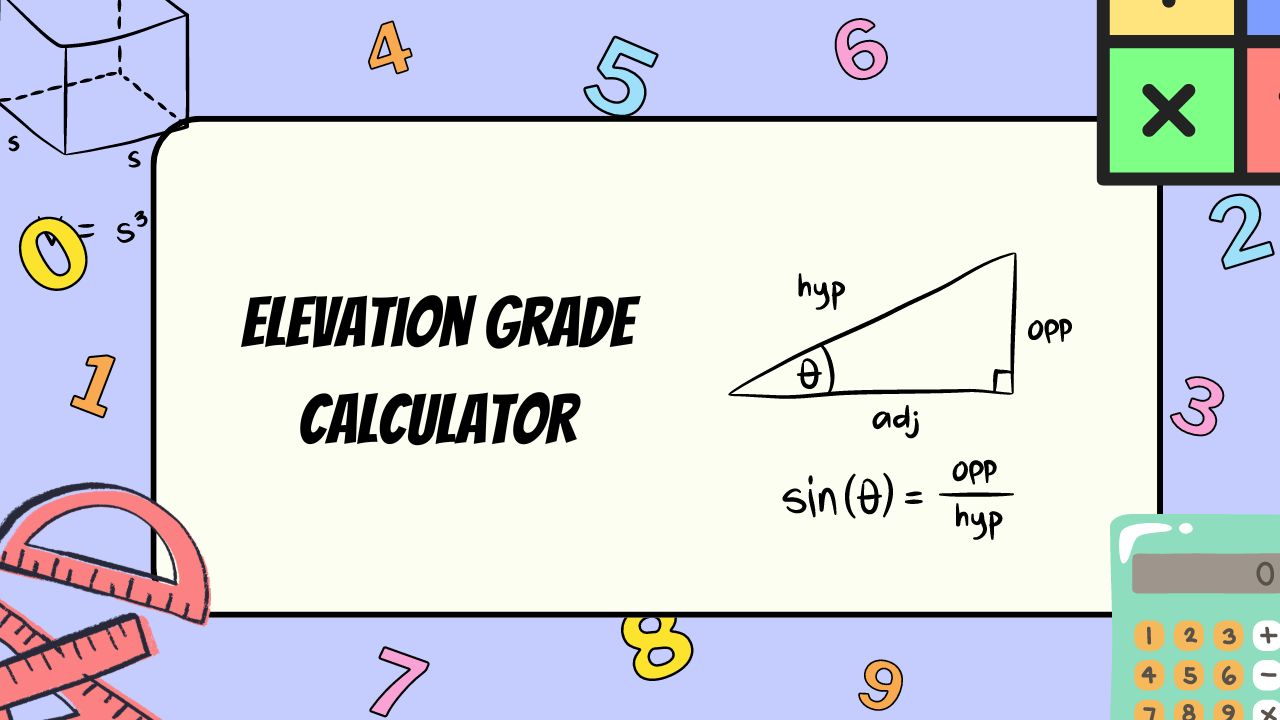
Elevation grade, also called slope, is calculated by dividing the vertical rise by the horizontal run.
Formula:
Grade=RunRise
The result is shown as a decimal.
Example
If a surface rises 12 meters over a horizontal distance of 100 meters:
12÷100=0.12
The decimal grade is 0.12.
How to Calculate Grade Percentage
To convert decimal grade into a percentage, multiply the decimal grade by 100.
Formula:
Grade percentage=(RunRise)×100
Example
Using a rise of 12 meters and a run of 100 meters:
(12÷100)×100=12%
The slope has a 12% grade. This means the elevation changes by 12 units for every 100 horizontal units traveled.
How to Calculate the Angle of Elevation
The angle of elevation is the angle formed between the sloped surface and a horizontal line.
Formula:
Angle in degrees=arctan(RunRise)×π180
Example
For a rise of 12 meters and a run of 100 meters:
arctan(12÷100)≈6.8∘
A 12% slope is approximately 6.8 degrees.
Grade, Percentage, and Angle Example
Assume you are calculating the slope of a driveway:
- Rise: 3 feet
- Run: 30 feet
Grade:
3÷30=0.10
Grade percentage:
0.10×100=10%
Angle of elevation:
arctan(0.10)≈5.7∘
The driveway has a decimal grade of 0.10, a grade of 10%, and an angle of approximately 5.7°.
Why Calculate Elevation Grade?
Knowing the grade of a slope helps you plan and evaluate:
- Driveways and parking areas
- Wheelchair ramps and access routes
- Drainage slopes and landscaping
- Roads, paths, and hiking trails
- Site grading and earthwork
- Roof, ramp, and stair-related layouts
Frequently Asked Questions
What is the difference between rise and run?
Rise is the vertical elevation change. Run is the horizontal distance between the same two points.
What does a 10% grade mean?
A 10% grade means the elevation changes by 10 units for every 100 horizontal units. For example, a road rises 10 feet over a 100-foot horizontal distance.
Is grade percentage the same as degrees?
No. Grade percentage and degrees both describe slope, but they use different measurements. A 100% grade equals a 45° angle, not 90°.
Can I use feet for rise and meters for run?
No. Use the same unit for both inputs. Convert one measurement first if needed.
What happens if the slope goes downward?
A downward slope has a negative rise and a negative grade. The calculator can show the direction of the slope through the sign of the result.
Is this calculator suitable for ramp or driveway design?
It is useful for quick planning and checking slope values. Final designs should still follow applicable local requirements, project specifications, and safety standards.
Check out 5 Similar Calculators: