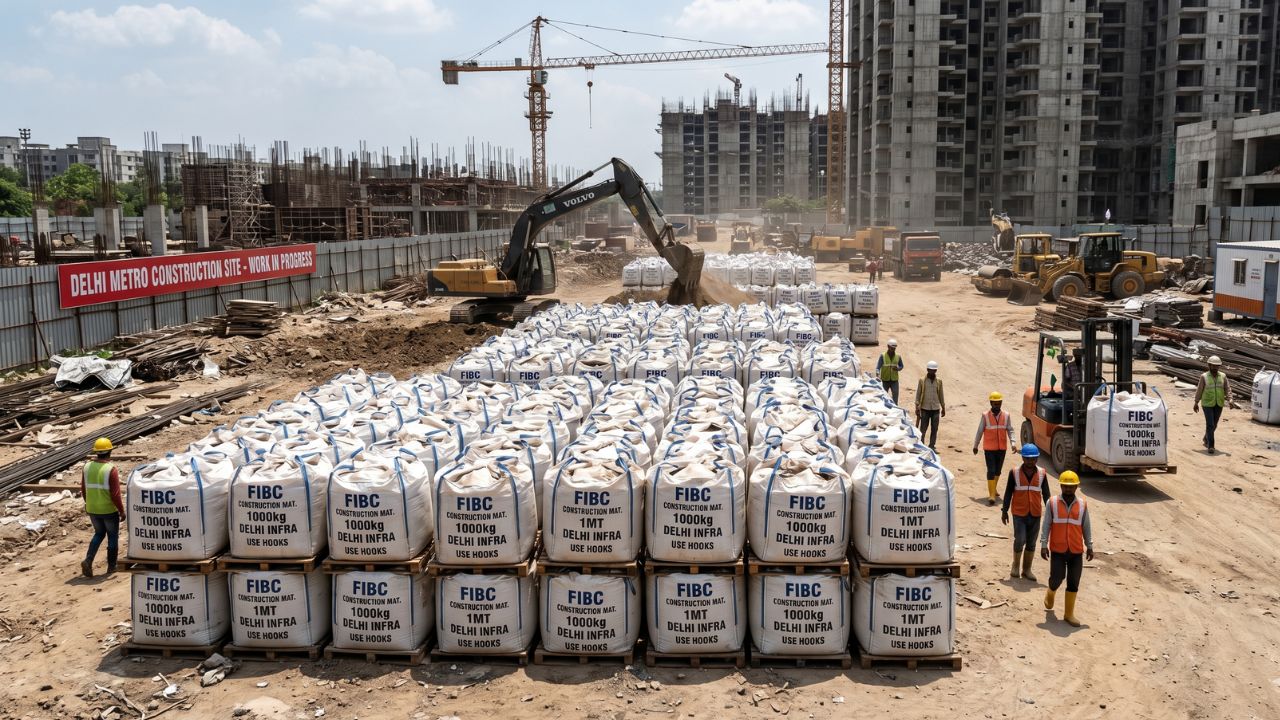
An FIBC Bag Weight Calculation Calculator helps estimate the weight and load capacity of Flexible Intermediate Bulk Containers (FIBC), also known as jumbo bags or bulk bags.
These bags are commonly used in construction, agriculture, mining, and industrial material handling for storing and transporting materials such as sand, gravel, cement, soil, fertilizer, and aggregates.
By entering the bag dimensions, material density, fill percentage, and number of bags, the calculator estimates the total material weight accurately.
Inputs Required
1. Bag Length: The total length of the FIBC bag.
2. Bag Width: The total width of the FIBC bag.
3. Bag Height: The total height of the FIBC bag.
4. Material Density: The density of the material stored inside the bag.
5. Fill Percentage (Optional): The percentage of the bag that is filled with material.
6. Number of Bags (Optional): The total number of FIBC bags.
FIBC Bag Volume Formula
The first step is calculating the total volume of the bag.
Volume=Length×Width×Height
Where:
- Length = Bag length
- Width = Bag width
- Height = Bag height
Filled Volume Formula
If the bag is partially filled, the effective filled volume is:
Filled Volume=Volume×100Fill Percentage
Material Weight Formula
The material weight is calculated using the filled volume and material density.
Weight=Filled Volume×Density
Total Weight Formula
If multiple bags are used:
Total Weight=Weight×Number of Bags
How the FIBC Bag Weight Calculator Works
The calculator first determines the total bag volume. Then it applies the fill percentage to calculate the actual filled volume. Finally, the filled volume is multiplied by the material density to estimate the total material weight.
This calculation is useful for:
- construction materials
- cement storage
- sand and gravel transportation
- agricultural products
- industrial bulk storage
Example Calculation
Suppose:
- Bag Length = 1.5 m
- Bag Width = 1.2 m
- Bag Height = 1.1 m
- Material Density = 950 kg/m³
- Fill Percentage = 85%
- Number of Bags = 4
Step 1: Calculate Bag Volume
Volume=1.5×1.2×1.1
Volume=1.98 m3
Step 2: Calculate Filled Volume
Filled Volume=1.98×10085
Filled Volume Result
Filled Volume=1.683 m3
Step 3: Calculate Weight Per Bag
Weight=1.683×950
Weight Result
Weight=1598.85 kg
Step 4: Calculate Total Weight
Total Weight=1598.85×4
Final Total Weight
Total Weight=6395.4 kg
Applications of FIBC Bag Weight Calculation
This calculator is useful for:
- Construction material handling
- Cement and aggregate transport
- Mining operations
- Agricultural bulk storage
- Industrial packaging
- Warehouse logistics
Benefits of Using an FIBC Bag Weight Calculator
- Fast and accurate weight estimation
- Helps avoid overloading
- Improves transportation planning
- Useful for warehouse management
- Reduces manual calculation errors
FAQs
What is an FIBC bag?
An FIBC bag is a Flexible Intermediate Bulk Container used for storing and transporting bulk materials.
What materials can be calculated using this calculator?
You can calculate the weight of:
- sand
- gravel
- cement
- soil
- fertilizer
- grains
- industrial powders
Why is fill percentage important?
Most jumbo bags are not filled completely. Fill percentage helps calculate the actual usable volume.
Which density unit should be used?
For construction and industrial calculations, density is commonly entered in:
kg/m3
Can this calculator estimate total load weight?
Yes, by entering the number of bags, the calculator estimates the total combined weight.
Check out 3 Similar Calculators: