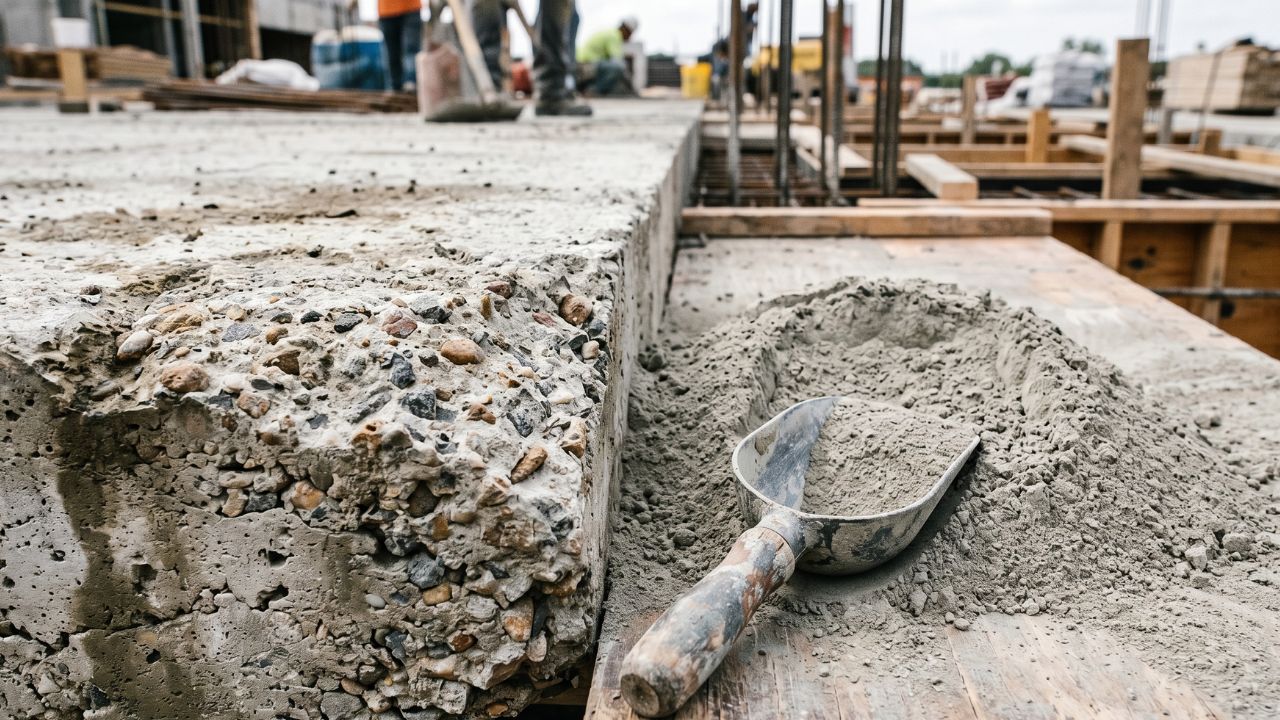
You hear both words thrown around constantly in home improvement projects, construction sites, and DIY conversations. "We need to pour some concrete." "Just mix up some cement." Most people use the two words interchangeably without a second thought.
Here's the thing — they're not the same material. Not even close. And once you understand the difference, you'll never mix up the terms again.
Let's break it down simply.
The Quick Answer
Cement is an ingredient. Concrete is the final product.
Think of it like baking. Flour is an ingredient. Bread is the final product made using flour along with other ingredients. You'd never say "I'm eating a slice of flour" — you'd say you're eating bread.
Same logic applies here. Cement is one ingredient mixed with other materials to create concrete. You don't pour a cement driveway. You pour a concrete driveway — which contains cement as one of its components.
What Is Cement?
Cement is a fine, gray powder made primarily from limestone and clay that have been crushed, heated to extremely high temperatures in a kiln, and ground into powder. This process is called calcination.
The most common type used today is Portland cement — named after the Isle of Portland in England because the resulting material resembled the natural stone quarried there.
On its own, cement powder doesn't do much. It's the binding agent — the glue. When mixed with water, cement undergoes a chemical reaction called hydration, which causes it to harden and bind other materials together.
Cement by itself is never used to build anything structural. It's always combined with other ingredients to create something usable — whether that's concrete, mortar, grout, or stucco.
How Is Cement Made?
Understanding the manufacturing process helps explain why cement behaves the way it does.
Step 1 — Raw Material Extraction
Limestone, clay, and small amounts of other minerals like iron ore and sand are mined and crushed.
Step 2 — Mixing and Grinding
The crushed raw materials are blended in specific proportions and ground into a fine powder called "raw meal."
Step 3 — Heating in the Kiln
The raw meal is fed into a massive rotating kiln and heated to around 2,700°F (1,450°C). At this extreme temperature, a chemical transformation occurs and the material forms small, hard nodules called clinker.
Step 4 — Grinding the Clinker
The clinker is cooled and ground into the fine gray powder we recognize as cement. Small amounts of gypsum are added during this final grinding stage to control the setting time.
This entire process is energy-intensive, which is one reason cement production is one of the more carbon-intensive industrial processes in the world — accounting for roughly 8% of global CO2 emissions according to industry estimates.
What Is Concrete?
Concrete is a composite construction material made by combining cement, water, sand, and aggregate (gravel or crushed stone) in specific proportions.
When you mix these ingredients together, the cement reacts with the water in the hydration process mentioned earlier. This chemical reaction causes the cement paste to coat the sand and aggregate particles and bind them all together into a solid, rock-hard mass as it cures.
The basic concrete formula looks something like this:
A typical concrete mix by volume breaks down roughly as follows:
| Ingredient | Approximate Percentage |
|---|---|
| Aggregate (gravel/crushed stone) | 41% |
| Sand | 26% |
| Cement | 11% |
| Water | 16% |
| Air | 6% |
Notice that cement actually makes up a relatively small portion of the total concrete mix — usually around 10% to 15% by volume. It's the most expensive and chemically active ingredient, but it's far from the majority component by volume.
The Visual Difference
If you're standing in a hardware store trying to figure out which bag to buy, here's a simple way to tell them apart:
Cement comes in bags as a fine, smooth gray powder. It looks almost like flour or baby powder. There are no visible chunks, stones, or aggregate of any kind. A bag labeled simply "Portland Cement" is pure cement with no sand or gravel mixed in.
Concrete mix comes in bags that contain a noticeably coarse, gritty blend. You can see and feel the sand and small stones mixed throughout the gray powder. A bag labeled "Concrete Mix" already has cement, sand, and aggregate pre-blended — you just add water.
If you accidentally buy a bag of pure cement thinking it's concrete mix, you'll end up with a brittle, cracked mess once it cures. Pure cement paste without aggregate shrinks excessively as it dries and has very poor structural strength on its own.
Why Aggregate Matters So Much
This is the part most people don't realize — the sand and gravel in concrete aren't just filler. They're doing real structural work.
Aggregate provides bulk, strength, and stability to the mix. Without it, the cement paste would shrink significantly as it cures, leading to cracking and a weak final product. The aggregate particles essentially act as a skeleton that the cement paste binds together — distributing stress and resisting cracking far better than cement paste alone ever could.
This is also why concrete is measured by compressive strength — typically rated in PSI (pounds per square inch) in the US or MPa (megapascals) in the UK and Canada. Standard residential concrete is usually rated around 3,000 to 4,000 PSI (20 to 28 MPa), while structural and high-load applications may require 5,000 PSI (35 MPa) or higher.
Cement vs. Concrete — Side-by-Side Comparison
| Feature | Cement | Concrete |
|---|---|---|
| Form | Fine gray powder | Mixed solid material (wet or cured) |
| Composition | Limestone, clay, gypsum | Cement, water, sand, aggregate |
| Function | Binding agent | Final structural building material |
| Used alone? | Almost never | Yes — this is the finished product |
| Strength alone | Weak, brittle, shrinks heavily | Strong, durable, load-bearing |
| Common uses | Ingredient in concrete, mortar, grout | Driveways, foundations, sidewalks, patios |
| Cost | More expensive per pound | Less expensive per pound (bulk material) |
| Drying behavior | Hydration reaction, hardens with water | Cures over weeks, gains strength over time |
What About Mortar? Isn't That the Same Thing Too?
While we're clearing up confusion — mortar deserves a quick mention since it gets mixed into this conversation often.
Mortar is another cement-based product, but it's made from cement, sand, and water — without the larger aggregate (gravel or crushed stone) found in concrete. It's specifically formulated to be more workable and adhesive, which makes it ideal for bonding bricks, blocks, and stones together.
Think of it this way:
Mortar is designed to be spread thinly between bricks and stones as a bonding agent. Concrete is designed to be poured in mass quantities to create structural slabs, foundations, and load-bearing elements.
You'd never build a driveway out of mortar — it lacks the strength and bulk that aggregate provides. And you'd never use concrete to lay bricks — it's too coarse and not workable enough for that precision application. Calculate Cement, Sand, and Aggregate
How Concrete Cures and Gains Strength
One more important distinction — concrete doesn't just "dry." It cures through an ongoing chemical reaction that continues for weeks after it's poured.
The hydration reaction between cement and water doesn't stop once the surface looks dry. It continues happening internally as long as there's enough moisture present. This is why proper curing — keeping the concrete moist during the first several days — is so critical to achieving full strength.
Here's a general timeline of concrete strength gain:
| Time After Pour | Approximate Strength Achieved |
|---|---|
| 24 hours | ~16% of full strength |
| 3 days | ~40% of full strength |
| 7 days | ~65% of full strength |
| 28 days | ~99% of full strength (industry standard benchmark) |
This is why concrete is always rated at 28-day strength in the industry — that's the point where it's considered to have reached its design strength for engineering purposes. The reaction technically continues even beyond 28 days, just at a much slower rate.
Common Misconceptions
"Cement and concrete are basically the same thing."
False — as we've covered, cement is one ingredient and concrete is the finished composite material made from cement plus other components.
"You can use cement and concrete interchangeably in projects."
False — using pure cement instead of concrete mix for a structural application like a patio or driveway will result in a weak, heavily cracked surface because there's no aggregate providing structural bulk.
"Concrete dries and that's when it's done."
False — concrete cures through an ongoing chemical reaction. It doesn't simply dry like paint. Keeping it moist during the initial curing period is essential for reaching full strength.
"All cement is the same."
False — there are several types of Portland cement formulated for different applications, including faster setting times, sulfate resistance, and lower heat generation for large pours. There are also alternative cement types like Portland-limestone cement, which has a lower carbon footprint.
Why This Distinction Actually Matters
This isn't just a vocabulary lesson. Understanding the difference matters in a few practical ways:
Buying the right product. If you're doing a DIY project and need to patch or pour something structural, you need concrete mix — not pure cement. Grabbing the wrong bag at the hardware store leads to a failed project.
Understanding contractor quotes. When a contractor talks about "cement work," they almost always mean concrete work. Knowing the distinction helps you ask better questions and understand exactly what materials and processes are involved in your project.
Estimating costs accurately. Cement is sold separately and priced differently than ready-mix concrete or bagged concrete mix. Understanding which one you actually need affects your budget and your shopping list.
Better communication with professionals. Whether you're getting a quote for a driveway, foundation, or patio, using the correct terminology helps you communicate clearly with contractors and avoid misunderstandings about scope and materials.
Bottom Line
Cement and concrete are related, but they are not the same material. Cement is the fine gray powder made from heated limestone and clay that acts as the binding agent. Concrete is the final building material — created by mixing cement with water, sand, and aggregate — that actually gets poured into driveways, foundations, sidewalks, and patios.
Next time someone talks about "pouring cement," you'll know what they really mean — and you'll understand exactly what's happening in that mixing truck before it ever touches the ground.