A Ladder Angle and Length Calculator helps you estimate the ladder length needed to reach a wall or support point and calculate the angle between the ladder and the ground.
Enter the wall height and the horizontal distance from the wall to the ladder base. The calculator returns the ladder length and setup angle.
This calculator is intended for leaning, non-self-supporting ladders. Always follow the ladder manufacturer’s instructions and applicable safety requirements.
How to Use the Ladder Angle and Length Calculator
Enter the following measurements:
- Wall height
- Distance from wall
The calculator returns:
- Ladder length
- Ladder angle
Use the same measurement unit for wall height and distance from the wall, such as feet, metres, inches, or centimetres.
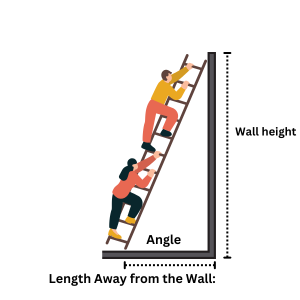
Understanding Wall Height and Base Distance
- Wall height is the vertical distance from level ground to the point where the ladder contacts its upper support.
- Distance from wall is the horizontal distance from the wall or upper support to the base of the ladder.
- Ladder length is the diagonal distance from the ladder base to its upper support point.
Calculate Ladder Length
The ladder, wall, and ground form a right triangle. Use the Pythagorean theorem to calculate the ladder length.
Ladder Length=Wall Height2+Distance from Wall2
Calculate Ladder Angle
The ladder angle is measured between the ground and the ladder.
Ladder Angle=tan−1(Distance from WallWall Height)
Example Calculation
Suppose you need to reach a wall height of 10 feet and place the ladder base 2.5 feet from the wall.
- Wall height: 10 feet
- Distance from wall: 2.5 feet
Calculate Ladder Length
Ladder Length=102+2.52
Ladder Length=100+6.25=10.31 ft
The ladder needs a working length of approximately 10.31 feet to reach the support point.
Calculate Ladder Angle
Ladder Angle=tan−1(2.510)
Ladder Angle=75.96∘
The ladder angle is approximately 75.96 degrees.
Use the 4:1 Ladder Setup Guide
For a leaning ladder, a common safety guideline is the 4:1 rule. Place the ladder base approximately one-quarter of the ladder’s working length away from the wall or upper support.
Base Distance≈4Working Length
This setup produces an angle of approximately 75.5 degrees from the ground.
Important Ladder Safety Notes
- Place the ladder on firm, level, non-slip ground.
- Secure the ladder at the top whenever possible.
- Keep the ladder base from moving or slipping.
- When using a ladder to access an upper level, allow the side rails to extend above the landing as required.
- Inspect the ladder before use and do not use damaged equipment.
- Keep your body centred between the ladder rails while climbing.
- Do not use metal ladders near overhead power lines or exposed electrical equipment.
- Follow the ladder’s duty rating, labels, and manufacturer instructions.
Frequently Asked Questions
What is the recommended angle for a leaning ladder?
A leaning ladder is commonly set at approximately 75.5 degrees from the ground. This is associated with the 4:1 setup guide.
What is the 4:1 ladder rule?
The 4:1 rule means the ladder base should be positioned about one-quarter of the working ladder length away from the wall or upper support.
Is wall height the same as ladder length?
No. Wall height is the vertical distance to the upper support point. Ladder length is the longer diagonal distance from the ladder base to that point.
What happens if a ladder is too steep or too shallow?
An incorrect setup angle can make the ladder less stable. Reposition the ladder on level ground and follow the manufacturer’s setup instructions.
Does the calculated ladder length include the extension above a landing?
No. The calculation gives the distance from the ladder base to its upper support point. Add the required ladder extension when using the ladder to access an upper landing.
Can I use this calculator for a step ladder?
No. This calculator is for a leaning, non-self-supporting ladder. A step ladder should be used only in its fully open, locked position and according to its manufacturer instructions.
Can I use feet, metres, inches, or centimetres?
Yes. Use any unit, but enter wall height and distance from the wall using the same unit.
Check out 14 Similar Calculators: